




Can You Use a Type 2 Cable as an Extension Lead?
It usually happens when you least expect it. You pull into the driveway after a brutal rainstorm, pop your charge port, and realize the wallbox gun stops just a couple of feet shy. Or maybe you're at a public station, and someone badly double-parked, leaving you stranded one bay over.
Naturally, the thought hits you: Can you use a Type 2 cable as an extension lead?
The short answer is yes, but there’s a big technical caveat. You can’t just grab two standard charging cables from your boot and plug them end-to-end. Regular Type 2 cables have male pins on both sides, meaning they physically won't fit together. To bridge that gap safely, you need a dedicated male-to-female lead designed from the ground up for high-voltage AC loads.
(Speaking of driveways, if you've ever tried unwinding a frozen, stiff cable at 6 AM in the dead of winter, you already know why cable jacket materials matter way more than people think—but more on that in a second.)
How Male-to-Female Extension Leads Actually Talk to Your Car
To understand why a proper extension works when daisy-chaining doesn't, you have to look at what’s happening inside the plug handles.
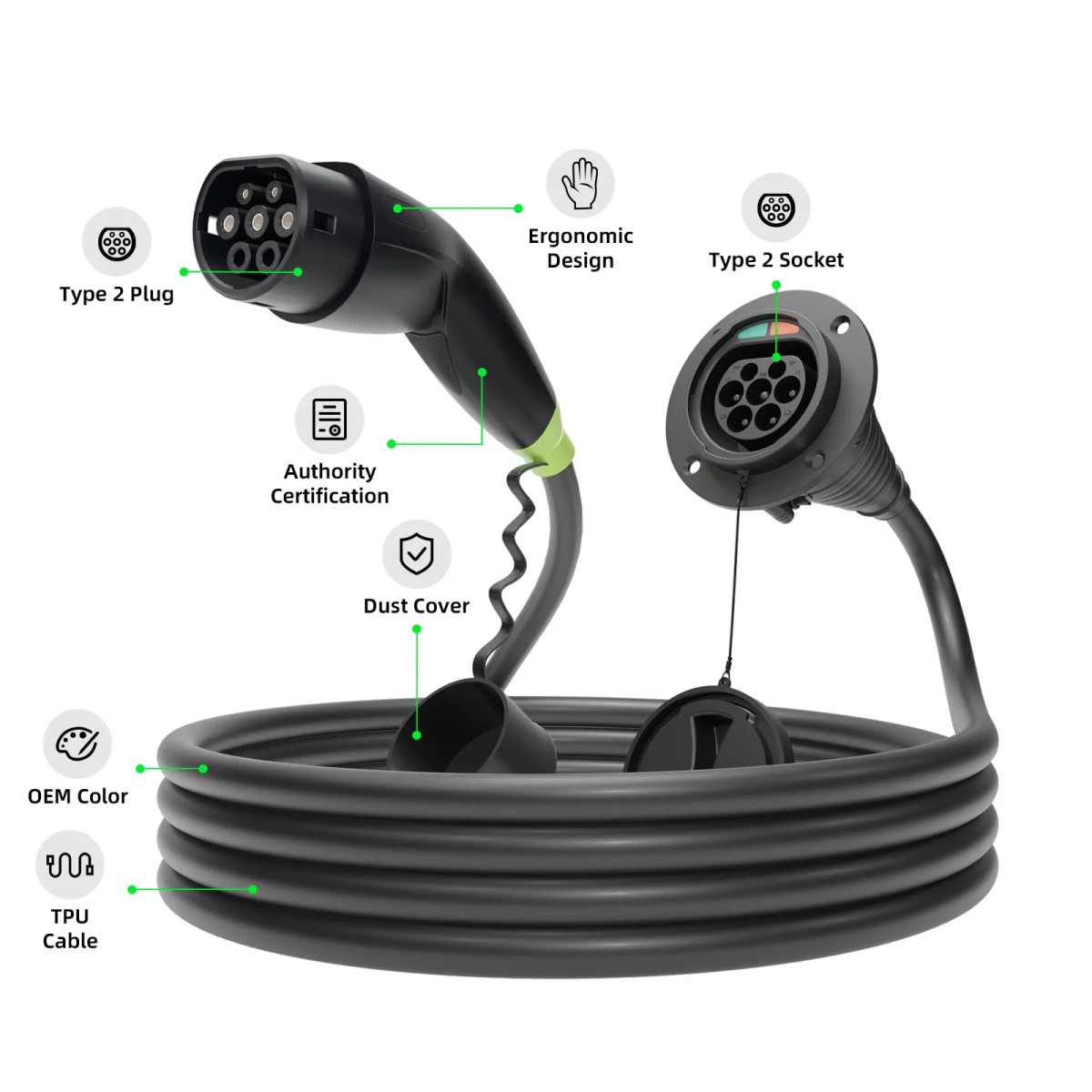
A purpose-built ev type 2 extension cable has a female socket on one end and a male plug on the other.
When you attach the female socket to your existing wallbox gun, the internal Control Pilot (CP) and Proximity Pilot (PP) pins maintain a continuous signal loop. Your vehicle doesn't even realize there's an extra wire in the middle; it performs the standard safety handshake with the charger, locks the latch pins, and begins drawing power.
Choosing Specs That Won't Melt Your Garage Socket
Unlike a household lamp or a hedge trimmer, electric cars pull continuous heavy Amperage (16A to 32A) for six or eight hours straight. That is a massive thermal load. Buying a cheap, poorly gauged extension cord on an unverified marketplace is an invitation to melted plastic or blown breakers.
Here is what you actually need to check before picking an ev charger type 2 extension cable:
Amperage Matching & Single vs. Three-Phase
For most residential single-phase setups running at 32 Amps, a 7kw type 2 extension cable matches your wallbox's maximum output without creating a bottleneck. That said, if you happen to have a 3-phase supply installed—or if you rent commercial workshop space—a 32A 3-phase option rated for 22kW (480V) gives you total flexibility. A 22kW cable handles a 7kW home load effortlessly without heating up, making it a solid future-proofing move.
Real-World Reach: The 5m Sweet Spot
Be realistic about distance. For a typical double garage or a standard suburban driveway, a type 2 extension cable 5m lead gives you more than enough slack to wrap around an adjacent vehicle without coiling metres of dangerous, heavy wire all over the floor.
(Quick tip from experience: always uncoil your extension cable fully when charging at high amperage. Leaving a cable tightly coiled on the ground creates an induction loop that traps heat, which isn't great for the insulation long-term.)
Insulation: Why TPU Easily Beats Cheap PVC
Because these cables spend half their lives lying in wet puddles, cold mud, or gravel, the outer sheathing takes a beating. Cheap PVC jackets become rigid as iron when temperatures drop below freezing, making them a nightmare to roll back up. Look for Thermoplastic Polyurethane (TPU) instead—it stays flexible in sub-zero weather, tolerates being accidentally driven over, and resists oil and UV breakdown.
What About Brand Compatibility? (Tesla, CCS2 & International Standards)
A frequent concern among drivers is whether adding an extension will trigger fault codes on specific car computers.
Because Type 2 is governed by the global IEC 62196 standard, the pin architecture is universal across Europe, Asia-Pacific, and Oceania:
Tesla & Global EV Fitment: Whether you drive a European hatchback, an Asian electric SUV, or a Tesla, a certified extension lead passes power cleanly. It functions seamlessly as a tesla type 2 extension cable for Model 3, Model Y, and S/X vehicles fitted with Type 2 ports.
CCS2 Port Friendly: Since CCS2 DC fast-charge ports use the standard Type 2 pin layout on their upper AC section, a ccs type 2 extension cable plugs straight in for Level 2 AC home or workplace charging.
(Interestingly, in markets like Australia and New Zealand where houses often feature long carports set far back from the main garage wall, extension leads are actually one of the very first accessories new EV owners end up buying.)
Heavy-Duty Reliability: The EVSEClub Max 22kW Cable
If you need a cable that solves your reach issues without compromising on safety or charge speed, the EVSEClub Type 2 Extension Cable (Max 22kW) is engineered for tough daily use.
Built for home garages, shared workplace bays, and commercial fleet depots, our extension lead offers:
Full 22kW Fast AC Support: Rated up to 32A / 480V across single-phase and three-phase supplies, ensuring zero power drop whether pulling 7.4kW or 22kW.
Tested for the Elements: Covered in heavy-duty TPU sheathing tested for over 10,000 mating cycles, equipped with IP-rated dust caps to shield copper contacts from rain, dirt, and road salt.
Universal Fitment: Plugs clean into all global Type 2 wallboxes, public stations, and EV ports.
The Bottom Line
Can you use a Type 2 cable as an extension lead? Absolutely—as long as it’s a purpose-built male-to-female lead rated for high, continuous AC current.
Don't let a short wallbox cord force you into awkward parking maneuvers every evening. Upgrade your setup with a certified, heavy-duty extension solution that makes charging simple and worry-free.
👉 [Contact the EVSEClub Team Today]to inquire about B2B bulk orders or order your EVSEClub Type 2 Extension Cable (Max 22kW)!